Architecture

Turin’s Castello di Rivoli Tells a Story of the Region’s History through Its Architecture

Given the sheer magnitude and influence of its recorded history, Italy as we know it is a surprisingly young country. For centuries, the region was divided between powerful (and sometimes warring) city-states, each with their own identity, culture, and, fortunes, and influence. Some are eternally famous. Rome is a cradle of history and heart of religion; cool Milan is a hub of contemporary fashion and design; Florence is synonymous with the Renaissance and all the epoch’s relationship to the arts.

Turin’s history is arguably less romantic. The small city in Savoy, a north-Italian region bordering France, has established an identity as an industrial powerhouse. It is home to FIAT and some of Italy’s finest universities; the streets are dotted with works by Nervi, Botta, and Rossi. But despite the design pedigree, perhaps nothing better illustrates the region’s faceted history better than Castello di Rivoli.


Humanity has become obsessed with breaking its limits, creating new records only to break them again and again. In fact, our cities’ skylines have always been defined by those in power during every period in history. At one point churches left their mark, followed by public institutions and in the last few decades, it’s commercial skyscrapers that continue to stretch taller and taller.

But when it comes to defining which buildings are the tallest it can get complicated. Do antennas and other gadgets on top of the building count as extra meters? What happens if the last floor is uninhabitable? The Council on Tall Buildings and Urban Habitat (CTBUH) has developed their own system for classifying tall buildings, measuring from the “level of the lowest, significant, open-air, pedestrian entrance to the architectural top of the building, including spires, but not including antennae, signage, flag poles or other functional-technical equipment.” Using this system more than 3,400 buildings have been categorized as over 150 meters tall.

These Are the World’s 25 Tallest Buildings
04:00 – 24 January, 2019
These Are the World’s 25 Tallest Buildings, © Marshall Gerometta/CTBUH; © zjaaosldk, bajo licencia CC0; © Carsten Schael; © K11 / New World Development; © © Ferox Seneca, bajo licencia CC BY 3.0; imagen cortesía de SOM

Architecture, the art and technique of designing and building, as distinguished from the skills associated with construction. The practice of architecture is employed to fulfill both practical and expressive requirements, and thus it serves both utilitarian and aesthetic ends.

Every drawing on our boards tells a story that may only be experienced in that precise setting. Our architectural design leaders, backed by our integrated design team, work with entrepreneurs and developers in dynamic collaboration

Designing destinations for the hospitality and leisure sectors, our architectural vision is informed by our deep understanding of the needs of operators and guests. We are attentive in every project to the operational and design needs for predominant business activities, such as food and beverages and leisure and retail services.

DINAMOS

Description sent by the project team. The house was built in an area south of Mexico City in the old town of La Magdalena, bordering the river of the same name. The Magdalena River descends from the forest of Los Dinamos, and is the last living river in Mexico City.

https://www.archdaily.mx/mx/02-252889/casa-del-rio-jose-alfonso-quinones-rios

https://www.archdaily.com/articles

https://www.watg.com/expertise/architecture/h

Martínez Domínguez Jenny Berenice

Pérez Heredia Erick

Silva Reynoso Diana Laura

ENGLISH

The English III program is varied and functional for everyday life; using perfect present, past, future and present continuous.

Present Continuous

There are three cases to use the perfect present well. And then a couple of cases where it’s not used.
But first of all, the perfect present is formed with the auxiliary verb have / has and a past participle. The past participle is the third column of the list of irregular verbs, or if it is regular, it ends in -ed.
First, the three cases:
Something recent that impacts on the present.
Something that started in the past and continues now.
Experience at some point in your life – without saying when

https://www.curso-ingles.com/practicar/ejercicios/present-continuous

Present perfect

Present continuous is the verb tense we use to describe actions that are occurring at this moment, that is, at the moment in which we are speaking.
It is composed of the verb to be in the present simple plus a verb in gerund (ending in -ing).
The golden rule is that 99% of the time we use it, we contract when we speak. Do your best to learn the contracted form:
I am looking at the map.
I’m looking at the map.
You are looking at the map.
You’re looking at the map.

To práctica speaking we’ve decided to introduce two of our teachers, in order to understand and explain a little bit of the function of the present perfect.

https://www.curso-ingles.com/practicar/ejercicios/present-perfect-vs-past-simple

https://www.facebook.com/groups/110882199583324/permalink/121161191888758/

https://www.facebook.com/groups/110882199583324/permalink/121084845229726/

https://www.facebook.com/groups/110882199583324/permalink/122958031709074/

Cruz Martínez Andrea. De la Rosa Avendaño Carlos. Rosas Lopez Sandra.

XOCHIMILCO

The lungs of the city

Ver las imágenes de origen
CDMX

Why was we choosen it? The lacustrine system that includes Xochimilco is the most important in the Valley of Mexico, the livelihood of millions of inhabitants and hundreds of species of plants and animals.

https://goo.gl/maps/acTnY8MP9Zk

The channels and chinampas of Xochimilco are contaminated every day by more than 2000 discharges of sewage. Considered a Cultural patrimony of humanity, Xochimilco suffers from the discharge of pipes from housing areas and companies that are dedicated to the breeding of pigs, some of them were installed by the same authorities.
A census carried out by the Institute of Engineering of the UNAM, supported by the secretariat of Science of the DF and a group of canoeists of the zone, along 116 kilometers of the channels of this tourist zone was carried out for a whole year , navigating the canals in a kayak.
Dr. Rosario Iturbe Argüelles, specialist of the UNAM in soil sanitation and contaminated water was the coordinator of this investigation, noting that of all the discharges made in the channels, 602 were of black waters and 771 of gray waters, although not All the downloads came from the houses.

San Gregorio, one of the towns of Xochimilco, has been affected by drainage discharges, with a bad smell that reaches the completely contaminated houses and canals where there was clean water. The census recorded that this is one of the largest areas that are contaminated, where the dirty water never ceases to sprout. A few meters from that exit are chinampas where purple lettuce is cultivated, which is sold in some supermarkets in Mexico City. With the bad smell the flies arrive, and in times of heat the inhabitants keep their houses and windows closed to prevent that the stench enters their homes.
This census by UNAM and the Federal district government was exhaustive, although it did not cover all the channels. There are some areas that were unreachable due to the high pollution of garbage. In these places, the houses do not have windows that give to the channels. Living in that place became a health risk,

Ver las imágenes de origen

In the territory of Xochimilco, there are 14 native peoples that preserve many traits of their traditional culture and indigenous heritage, despite the advance of urbanization. In addition, the mountains of the south and the lake area of ​​the center are part of the largest natural reserve in Mexico City.
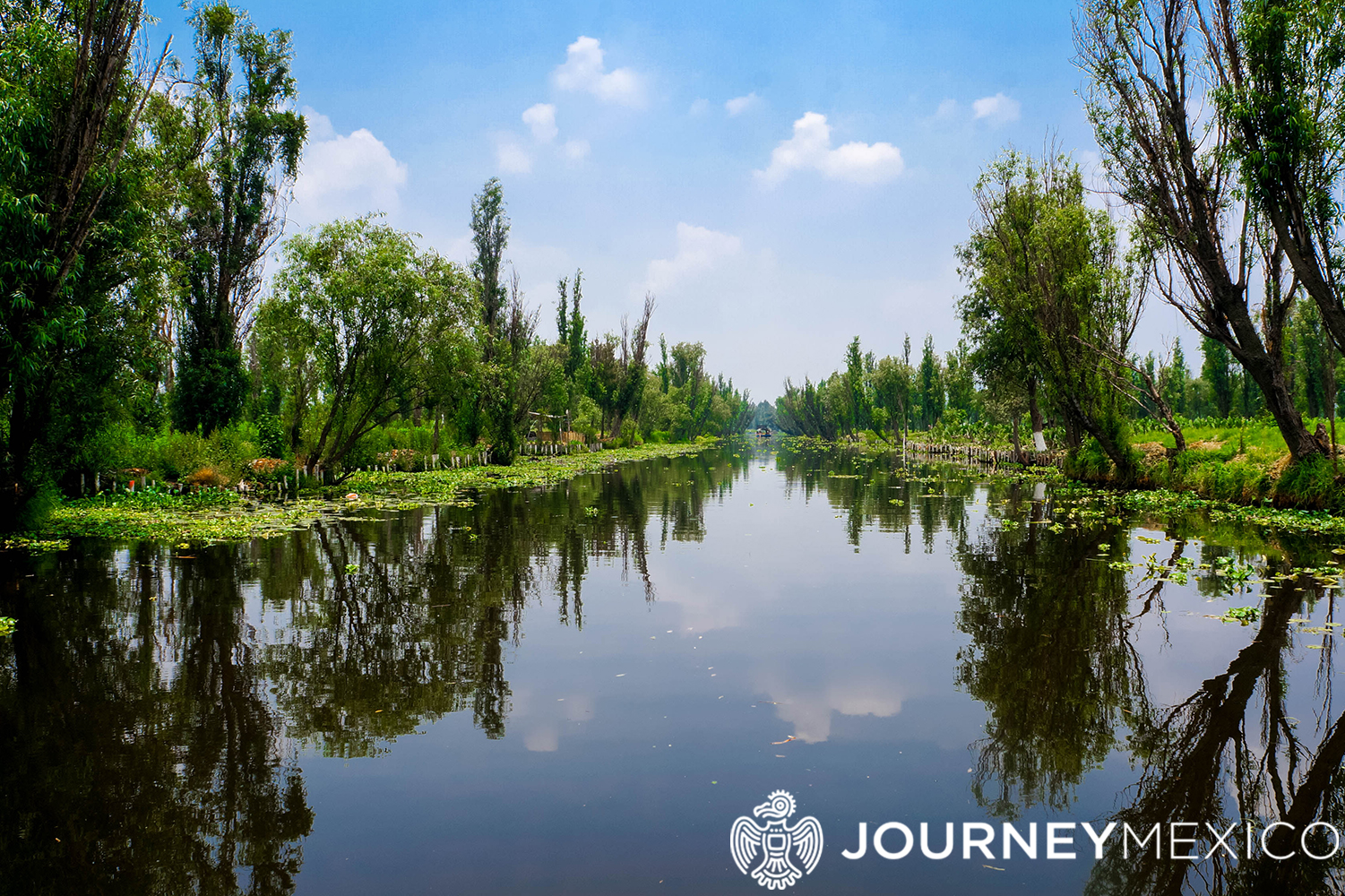
After the construction of chinampas, the ecosystem improved, because it allowed more contact with the ecosystem and creation of new species. The system allowed a profitable coexistence between human beings and nature. As the chinampas formed, the number and variety of trees in the ecosystem also increased. Particularly important is the ahuejote that served to hold the islands and favored the environment for the reproduction of aquatic fauna. The ahuejote is important in the ecosystem of Xochimilco because it controls soil erosion and forms windbreaks to protect crops.

https://www.jornada.com.mx/2008/08/11/index.php?section=capital&article=056n1cap

The vegetation typical of the lacustrine zone is formed mainly by hollows, typical of the region, planted in the past to fix the chinampas at the bottom of the lake and produce a large amount of oxygen. Other trees that also line the canals are the casuarinas, the willows, the alcanfores and the eucalyptus trees that share the place with plants such as: españadas, arrow leaves, gannets, tule, navajillo, lily and yellow, white and salmoned nymph, the latter in danger of extinction.

Fauna
Xochimilco has within its varied ecosystem, the presence of terrestrial, aquatic and aerial fauna given the conditions of each region, which allow the development and proliferation of different local and even migratory species.
Terrestrial Fauna
As for terrestrial fauna, Xochimilco has: hares, rabbits, Teporingos, weasels, opossums, squirrels, badgers, skunks, gophers, field mice, lizards, rattlesnakes and scorpions, to name a few.
Aquatic Fauna
Aquatic fauna consists of: tilapia or freshwater decanter, axolotl (endemic to the region), cencuate frogs, black water snake and duck, mainly.
Aerial Fauna
The species of aerial fauna is constituted by: White Heron, grey and silver; Hens, coots, water dog, gulls, magpies, pelicans (from California), owls, owls, hawks, Aguilillas, Cenzontles, Sparrows and calenders, among others.

https://www.facebook.com/groups/300779027342185/?ref=group_header

DINAMO’S PARK

Dinamos National park is a healing forest where you can find springs, mountains, rivers and huge green areas to practice ecotourism. It is a rural and ecological area, of the few that are to the south of the CDMX. It is called the dynamos because this is the name of four hydroelectric power generators that supplied the textile factories located right there.

CDMX

In its surroundings there are businesses where you can eat mushroom soup and quesadillas, or buy pulque.

The park is a ecotourism farm with forests, waterfalls and water falls from the Magdalena River, the last river in Mexico City

SENTENCES :
the food of the dynamos is very tasty

The dynamos are a nice place for a family day

Reaching the dynamos is quite easy

The dynamos also has activities to have fun

The dynamos are the only healing forest that is found in the city

https://www.facebook.com/groups/300779027342185/?ref=group_header

CRUZ MARTINEZ ANDREA . DE LA ROSA AVENDAÑO CARLOS. ROSAS LOPEZ SANDRA